
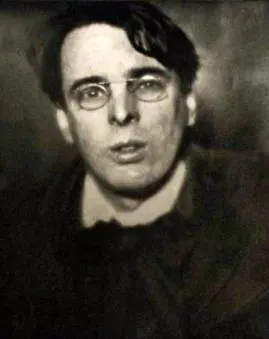
William Butler Yeats (1865-1939) is perhaps the most widely read of all Irish poets. As a boy, his father instructed him in the arts, while his mother instilled in him a love for the countryside. In his 20’s, he met Maud Gonne, an Irish revolutionary who would become the predominant muse of his life. Yeats pursued her unsuccessfully for over 20 years. In turn, she heavily influenced many of his poems. Later in life he even proposed to Gonne’s daughter.
Though Yeats’ poetry can be filled with the obscure folklore, Irish nationalism and mystical symbolism which both troubled and fascinated him, it can also appeal to everyday realities as well as the thoughts and feelings of the common man. Maud Gonne was most likely the tour de force behind the following poem:
When You Are Old
When you are old and grey and full of sleep,
And nodding by the fire, take down this book,
And slowly read, and dream of the soft look
Your eyes had once, and of their shadows deep;
How many loved your moments of glad grace,
And loved your beauty with love false or true,
But one man loved the pilgrim soul in you,
And loved the sorrows of your changing face;
And bending down beside the glowing bars,
Murmur, a little sadly, how Love fled
And paced upon the mountains overhead
And hid his face amid a crowd of stars.
Polysyndeton
Polysyndeton is a rhetorical device consisting of the repetition of conjuctions such as “and,” “but” and “or.” The obvious function of polysyndeton is to join units of language (words, clauses, etc.) together, but it is also a stylistic feature that can affect the rhythm and pace of both poetry and prose.
This poem by Yeats—the first stanza in particular—is rife with polysyndeton. Note that the poem is written in iambic pentameter, and that the conjunctions always serve as unaccented syllables to aid in the rhythm.
Next, look closely at the poem’s punctuation: the only period occurs at the end of the poem. This makes it read as though it were one uninterrupted succession of thoughts and actions. Alongside his punctuation choices, Yeat’s use of polysyndeton helps him achieve this effect.
Finally, polysyndeton works to speed up the pace of the poem, giving the reader less of a breath between pauses.
Challenge Prompt
Write a poem incorporating polysyndeton. Although “and” is probably the most popular conjuction used in polysyndeton, don’t forget that any conjunction is fair game. Try to use it to the benefit of your poem, as in one of the ways mentioned above.
Tip: Unless you’re doing it intentionally, try to avoid writing the “never-ending story” poem. This is a poem that sounds like an over-excited child talking about his or her day: “And we drew pictures of turkeys, and we played on the slides, and we…”