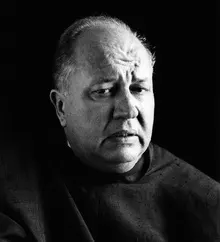
Theodore Roethke (1908-1963) was one of the most influential American poets of the 20th century. Roethke grew up around a large greenhouse facility, his father and uncle’s business. As a result, his poetry demonstrates a keen intimacy with the natural world. When Roethke was fourteen, his father died of cancer and his uncle committed suicide. Roethke was further plagued by manic depression and occassional psychotic episodes. And to compound these issues, he picked up a drinking habit in college. However, Roethke remained a prolific poet and a passionate teacher beloved by his students all his life. He died of a heart attack in a friend’s swimming pool.
The Waking
I wake to sleep, and take my waking slow.
I feel my fate in what I cannot fear.
I learn by going where I have to go.
We think by feeling. What is there to know?
I hear my being dance from ear to ear.
I wake to sleep, and take my waking slow.
Of those so close beside me, which are you?
God bless the Ground! I shall walk softly there,
And learn by going where I have to go.
Light takes the Tree; but who can tell us how?
The lowly worm climbs up a winding stair;
I wake to sleep, and take my waking slow.
Great Nature has another thing to do
To you and me; so take the lively air,
And, lovely, learn by going where to go.
This shaking keeps me steady. I should know.
What falls away is always. And is near.
I wake to sleep, and take my waking slow.
I learn by going where I have to go.
The Villanelle
A villanelle is a poetic form using two refrains which recur throughout the poem, first alternately, and then as a couplet.
Look at the breakdown of the villanelle below. Lines A1 and A2 represent the two refrains that are going to recur throughout the form. They appear offset in the first stanza, alternate as the third line of successive stanzas, and form a couplet in the final stanza. The lower case a’s and b’s adhere to the rhyme scheme but are not refrains.
Villanelles are typically written in iambic pentameter, meaning each line has 10 syllables with the accent falling on every other syllable. They are also typically rhymed in an “a-b-a” rhyme scheme. However, these rules are flexible, and even refrains can be varied, as Roethke demonstrates with line A2. Roethke changes it to “And learn by going where to go” in the third stanza, and then to “And, lovely, learn by going where to go” in the fifth stanza. This allows him to maintain a more natural voice and to add a pleasant variation to his refrains.
Notice how the two refrains, taken in and of themselves, are not very specific or spectacular. However, their vagueness grants them a broader range of flexibility within the context of the preceding lines. Don’t be afraid to be a little obtuse when writing your refrains. Lastly, a villanelle needn’t be lyrical, but it’s worth noting how aptly Roethke has fixed his lyrical style to this form. And how he uses the refrains to build up whatever emotion he may be trying to evoke.
Breakdown of the Villanelle
A1 – I wake to sleep, and take my waking slow.
b – I feel my fate in what I cannot fear.
A2 – I learn by going where I have to go.
a – We think by feeling. What is there to know?
b – I hear my being dance from ear to ear.
A1 – I wake to sleep, and take my waking slow.
a – Of those so close beside me, which are you?
b – God bless the Ground! I shall walk softly there,
A2 – And learn by going where I have to go.
a – Light takes the Tree; but who can tell us how?
b – The lowly worm climbs up a winding stair;
A1 – I wake to sleep, and take my waking slow.
a – Great Nature has another thing to do
b – To you and me; so take the lively air,
A2 – And, lovely, learn by going where to go.
a – This shaking keeps me steady. I should know.
b – What falls away is always. And is near.
A1 – I wake to sleep, and take my waking slow.
A2 – I learn by going where I have to go.
Challenge Prompt
Write a poem using the villanelle form. Remember, as stated above, that there is plenty of room for experimentation and variation within this form. Limitations, such as form, can give your poem structure, but beware that too much limitation can oppress your voice. The meter needn’t be iambic pentameter. The rhymes can be slanted, or discarded altogether. The refrains can be altered, or rearranged. You might set out to write a poem in a traditional form like the villanelle only to find that it just doesn’t fit. If so, never hesitate to scrap that form and arrange your poem in a different form, in free verse, or even in prose.
Tip: Try writing your two refrains first (your poem is now almost halfway complete!). Make them count, and then build the rest of the poem around them. You can alter them as you go if necessary.
One thought on “The Lowly Worm Climbs Up A Winding Stair”