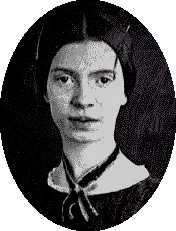
Emily Dickinson (1830-1886) was one of the most reclusive poets in history. She rarely left her home in Amherst, MA. After her death, her sister found almost 1800 poems in her room, less than a dozen of which had been published. Marked by a frequent use of dashes and slant rhymes, her style was considered unconventional by her contemporaries. Today, however, she is an unmistakable landmark of American poetry.
“My Life had stood – a Loaded Gun –”
My Life had stood – a Loaded Gun –
In Corners – till a Day
The Owner passed – identified –
And carried Me away –
And now We roam in Sovereign Woods –
And now We hunt the Doe –
And every time I speak for Him –
The Mountains straight reply –
And I do smile, such cordial light
Upon the Valley glow –
It is as a Vesuvian face
Had let its pleasure through –
And when at Night – Our good Day done –
I guard My Master’s Head –
‘Tis better than the Eider-Duck’s
Deep Pillow – to have shared –
To foe of His – I’m deadly foe –
None stir the second time –
On whom I lay a Yellow Eye –
Or an emphatic Thumb –
Though I than He – may longer live
He longer must – than I –
For I have but the power to kill,
Without – the power to die –
Personification
Personification is the attribution of human qualities to a non-human thing. In this poem, Dickinson personifies a gun. Observe the different ways Dickinson uses personification. Here are only a few of them:
The speaker of the poem (the “Loaded Gun”) reveals an intense relationship with its master (“The Owner”). Notice how Dickinson resists saying that the master sleeps with a gun under his pillow; instead, the gun says, “I guard My Master’s head.” Later on she suggests that the gun itself can kill anyone who poses a threat to its master: “To foe of His – I’m deadly foe –/ None stir the second time.” And in the final two lines, “For I have but the power to kill,/ Without – the power to die –“ Dickinson shows that the gun is capable of existential thought (in short, thinking about the “human” condition). Notice too how the final line, in turn, reveals the gun’s only non-human quality, which is also the source of its anxiety: it cannot die.
Challenge Prompt
Write a poem that personifies something. It can be an animal, an abstract idea or an inanimate object. Choose something interesting or valuable or ridiculous—a streetlamp in New York, the idea of perfection, the squirrel in your backyard—and give it thoughts, memories and actions. Bring it to life.
Tip: try writing about the object, and then replace any reference to the object with “I”.
One thought on “Emily Dickinson’s Gun”